By Editorial Staff
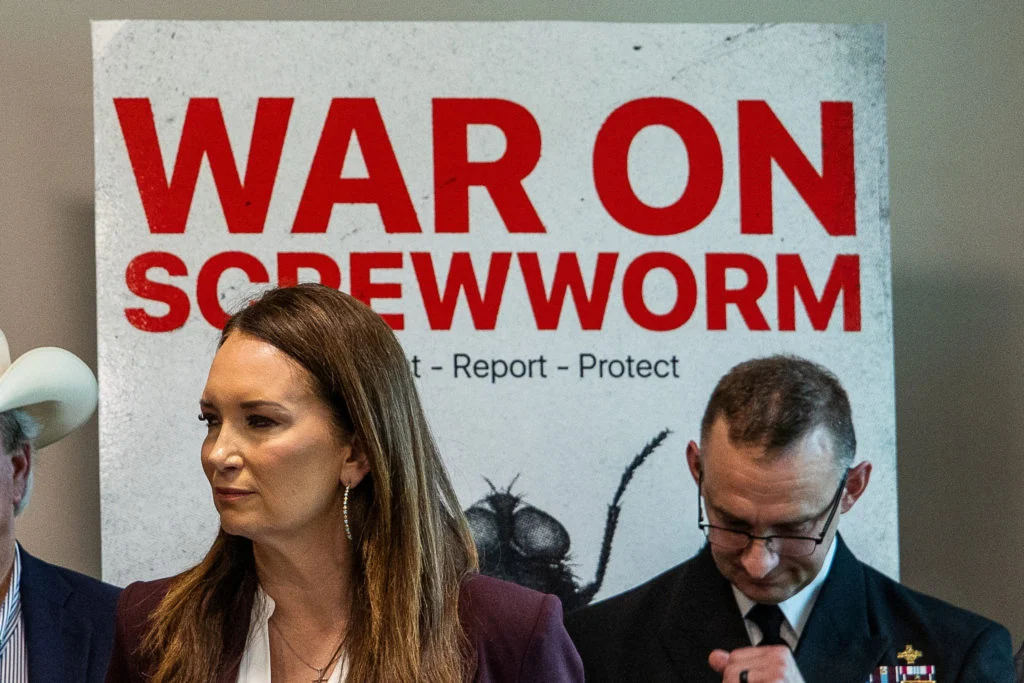
After six decades of relative peace, the American cattle industry faces a biological threat that many experts believed was confined to the history books. The New World screwworm—a parasitic fly that feeds on the living flesh of warm-blooded animals—has returned to the United States, prompting an aggressive, multi-faceted federal response. As U.S. Agriculture Secretary Brooke Rollins oversees the release of sterile flies across the Texas landscape, the nation finds itself locked in a high-stakes battle to prevent a localized infestation from escalating into a billion-dollar agricultural catastrophe.
The Anatomy of an Infestation
The New World screwworm (Cochliomyia hominivorax) is a devastating pest. Unlike common houseflies that lay eggs in decaying matter, the female screwworm fly targets the open wounds of living animals, including livestock, wildlife, and, in rare instances, humans. Once the eggs hatch, the larvae burrow into the living tissue, causing severe wounds, infection, and, if left untreated, death.
For ranchers, the presence of the fly is a logistical nightmare. Because the parasite can complete its life cycle in as little as three weeks under tropical conditions, the speed of infestation is brutal. Secretary Rollins, visiting a Texas ranch where a calf was recently saved from an infestation, emphasized the necessity of vigilance.
"He couldn’t be happier. He’s bouncing around the pasture," Rollins remarked of the recovered calf. However, her optimism is tempered by the gravity of the situation. The USDA has now confirmed multiple cases across Texas and New Mexico, triggering 12-mile quarantine zones around every detection point.
A Chronology of the Crisis
The resurgence of the screwworm marks a sudden reversal of one of the most successful eradication programs in history.
- The Mid-20th Century: Following a massive multi-national effort, the U.S. successfully eradicated the screwworm in the 1960s. The strategy, which involved the mass release of laboratory-sterilized male flies, was considered a triumph of entomological science.
- The Containment Era: For decades, the parasite was successfully pushed back and contained within the narrow Isthmus of Panama.
- 2023: The Breach: Without a clear scientific explanation for how they broke through the established containment zone, screwworms began a steady, alarming migration northward.
- 2024–2025: The Northward Advance: The parasite moved through Mexico, leading to more than 28,000 cases in that country. As the flies moved closer to the Rio Grande, international trade ground to a halt. The U.S. closed its southern ports to Mexican livestock, and in a reciprocal move, Mexico halted the importation of live animals from the U.S.
- Current Status: With seven confirmed cases in the U.S. to date, federal authorities have pivoted to a full-scale emergency response.
The Billion-Dollar Defensive Strategy
The USDA is preparing an "all-out assault" to push the screwworm back to the Isthmus of Panama. The financial stakes are immense, with estimates suggesting the federal government will spend over $1 billion to protect the domestic cattle industry.
The centerpiece of this response is a massive, $750 million investment in infrastructure. The USDA is building and operating a specialized facility capable of producing 300 million sterile flies per week. This technique exploits the biology of the species: female screwworms mate only once in their lifetime. By flooding the environment with sterile males, the reproductive capacity of the wild population is effectively neutered, causing the numbers to dwindle rapidly.
"The goal is to protect the U.S. cattle industry," officials stated. While experts currently believe that the screwworm will not cause an immediate spike in retail beef prices, they warn that this assumes the parasite remains contained. If the population spreads significantly, the impact on cattle mortality—and by extension, the beef supply chain—could be catastrophic.
The Role of Climate Change
Scientific consensus suggests that climate change is playing a significant role in the expansion of the fly’s range. The screwworm thrives in hot, humid environments, and as global temperatures rise, the "habitable" zone for these parasites is creeping further north.
"The fly is a creature of warmth as its entire life cycle, from egg to adult, can complete in as little as three weeks under tropical conditions," explained Lee Haines, an associate research professor of biological sciences at the University of Notre Dame.
Because the flies prefer temperatures above 77°F (25°C), the warming climate has effectively removed the natural thermal barriers that once kept these pests confined to the tropics. This shift has not only affected the U.S. and Mexico but has also led countries like Canada to temporarily suspend imports of horses and livestock from Texas, fearing the potential for northward migration of the pest.
Political Friction and Accountability
The emergence of the screwworm has sparked a sharp partisan divide in Washington. Secretary Rollins has consistently pointed to the current state of border security as a factor in the pest’s migration.
"People moving north to America, bringing their livestock with them, the Mexican cartels with the illicit cattle traffic—we knew it was coming," Rollins told the U.S. Senate Agriculture Committee. She suggests that the parasite may have been introduced via animals moved illegally across the border, bypassing standard quarantine and inspection protocols.
However, Democrats in Congress have pushed back aggressively, suggesting that the administration is looking for a scapegoat to cover for internal failures. A group of Democratic senators sent a formal letter to Rollins this week questioning whether staff reductions at the USDA’s Animal and Plant Health Inspection Service (APHIS) have compromised the agency’s ability to monitor livestock health.
The letter notes that nearly 20% of U.S. counties that had APHIS personnel at the start of 2025 ended the year without a single federal inspector on the ground.
Rep. Ted Lieu (D-CA) was particularly critical of the administration’s narrative. "The life cycle of a screwworm is about 14 to 54 days," Lieu stated. "The Trump administration has been in office for over 500 days. This is on the Trump administration. They need to own up to it, and they need to apologize."
Implications for Global Trade and Food Security
The screwworm crisis represents a significant threat to global agricultural stability. The interdependence of the North American beef market—where cattle move frequently between the U.S., Mexico, and Canada—means that a regional outbreak quickly becomes an international economic issue.
For the individual rancher, the daily reality is one of extreme caution. Experts like Jonathan Cammack, a professor of livestock entomology at Oklahoma State University, emphasize that there is no room for error.
"I don’t have the answer to [how they escaped Panama], and I don’t know if anyone does. It doesn’t help us to speculate," Cammack said. "The key now is to ramp up the sterile fly program and get international cooperation to get the pests back down to Panama."
As the USDA continues to redeploy over 100 employees to the screwworm task force, the industry remains on high alert. The success of the current $1 billion initiative will depend on more than just the release of sterile flies; it will require seamless cooperation between federal agencies, border authorities, and private ranchers.
Whether this outbreak is a temporary anomaly or the beginning of a long-term shift in the geography of agricultural pests remains to be seen. For now, the focus is singular: preventing the screwworm from gaining a permanent foothold on American soil. As Secretary Rollins and her team move to secure the nation’s herds, the entire agricultural sector watches closely, aware that the survival of the industry may depend on the success of a tiny, sterile fly.