





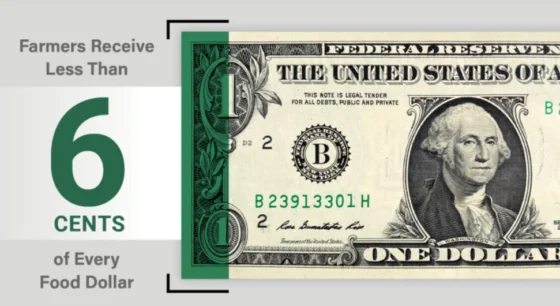
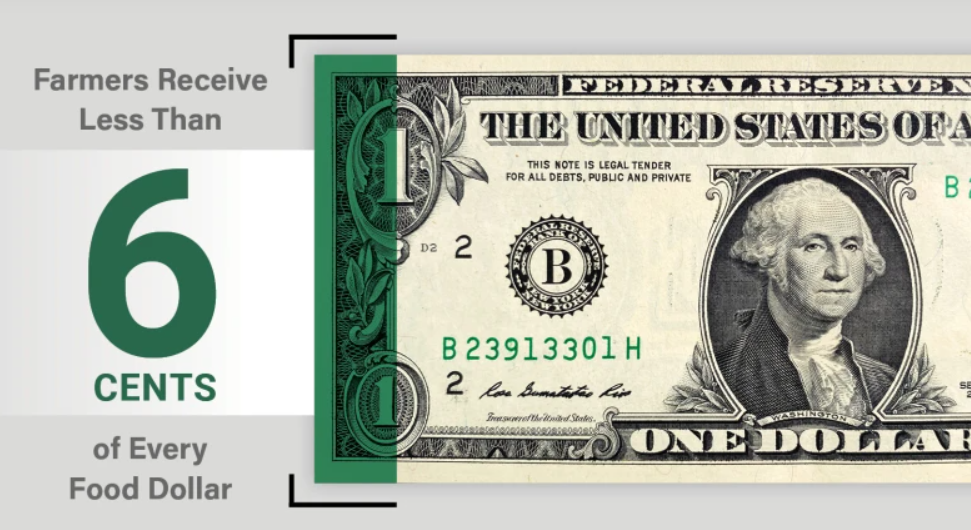
For decades, the American agricultural narrative has centered on the image of the independent family farmer—the backbone of the national economy and the steward of the land. Yet, fresh data from the U.S. Department of Agriculture (USDA) reveals a stark, sobering reality: the financial reward for those who actually grow our food has dwindled to a historic low. According to recent reports, farmers now receive less than six cents of every dollar spent on food in the United States. The remaining 94 cents are absorbed by a sprawling web of processors, retailers, distributors, and service providers.
This widening disparity highlights a structural crisis in the American food system, where the primary producers are increasingly sidelined by the very supply chains they sustain.
Main Facts: The Anatomy of a Food Dollar
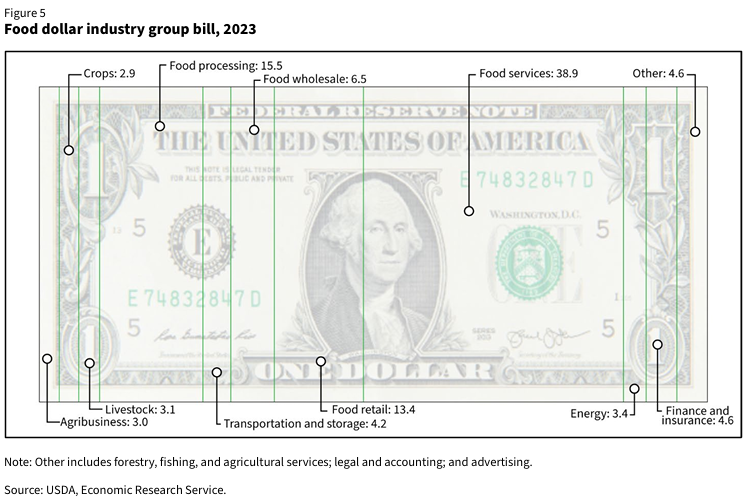
When a consumer walks into a grocery store or orders a meal at a restaurant, the price tag reflects a complex series of value-added processes. However, the "Food Dollar" series—a long-standing data project by the USDA’s Economic Research Service (ERS)—deconstructs exactly where that money goes.
The data is unequivocal: the "farm share" of the food dollar has been in a long-term decline. While the costs of processing, packaging, advertising, transportation, and retail markup have skyrocketed, the farmer’s portion has stagnated or shrunk.
Where the Money Goes:
- Processing and Manufacturing: This segment consistently claims the largest portion of the dollar, incentivized by the value added through preservation, packaging, and the creation of highly processed consumer goods.
- Retail and Food Service: Grocery stores and restaurant chains extract a significant premium for the convenience of availability and preparation.
- Transportation and Energy: As fuel costs and supply chain complexities rise, these logistical expenses are passed down the line, further compressing the margins available to the producer.
The disconnect is clear: the more "processed" a product becomes, the less the farmer sees of the final retail price. In an economy that rewards shelf-stability, branding, and convenience, the raw commodity producer is effectively treated as a low-margin input rather than a value-driven partner.
Chronology: A Multi-Decadal Decline
The decline of the farmer’s share is not a sudden phenomenon but a result of decades of industrialization and corporate consolidation within the agricultural sector.
- Mid-20th Century: Post-WWII agriculture saw the beginning of the "get big or get out" philosophy. As technology improved yields, the reliance on chemical inputs and industrial machinery increased, shifting costs from labor to capital.
- 1980s–1990s: The "Farm Crisis" of the 1980s saw a massive consolidation of land. Small and mid-sized family farms began disappearing at an accelerating rate as they struggled to compete with the economies of scale enjoyed by massive corporate operations.
- 2000s–2010s: The rise of globalized supply chains further distanced the farmer from the consumer. Middlemen proliferated, and the consolidation of food processors (such as the meatpacking industry) gave farmers fewer outlets to sell their goods, drastically reducing their bargaining power.
- 2020–Present: Recent inflationary pressures have widened the gap. While food prices for consumers hit record highs during the post-pandemic period, the increased revenue was largely captured by corporate entities rather than being passed back to the farm gate.
Supporting Data: The Disappearing Farm
The financial erosion of the agricultural sector is directly mirrored by the physical disappearance of the American farm. USDA chart data confirms a persistent downward trend in the total number of farms in the United States.
As profit margins tighten to razor-thin levels, small-scale operations are often forced to liquidate. The capital-intensive nature of modern farming—requiring expensive machinery, proprietary seeds, and high-cost fertilizers—makes it nearly impossible for new, young farmers to enter the industry without significant debt. This creates a vicious cycle: as farms disappear, the land is consolidated into fewer, larger holdings, which in turn reduces the number of independent voices in the market and further concentrates wealth in the processing and retail sectors.
The USDA’s "Food Dollar" series serves as an indictment of this model. When the farmer receives less than six cents on the dollar, they are not merely "less profitable"—they are often operating at a deficit, kept afloat only by government subsidies or off-farm income.
Official Perspectives and Industry Responses
The USDA remains the primary source of this data, providing the statistical backbone for researchers and policymakers to assess the health of the food system. However, the agency’s reports often present these figures in a clinical, technical manner that obscures the human impact.
Industry groups, particularly those representing large-scale food processors and retail chains, often argue that the "value-added" components of the food dollar are necessary to meet consumer demand for convenience, safety, and variety. They contend that modern supply chains are highly efficient, even if that efficiency is primarily optimized for the profit of the middleman rather than the producer.
Conversely, agricultural advocates argue that the USDA’s current reporting methods fail to capture the true cost of environmental degradation, rural poverty, and the loss of local food sovereignty. They point to the "Food Dollar" data as evidence that the system is currently "working" only for shareholders in the food processing industry, not for the farmers or the environment.
Implications: The Need for a New Farm Bill
The current situation poses an existential threat to American food security and rural stability. If the agricultural sector continues to hollow out, the nation risks losing the infrastructure of local food production, leaving the population entirely dependent on a fragile, highly centralized global supply chain.
A Call for Structural Reform
The upcoming Farm Bill represents a potential—though currently uncertain—opportunity for meaningful change. Critics argue that simply tweaking existing programs will not suffice. Instead, a "start-from-scratch" approach is required, focusing on two foundational goals:
- Promoting Regenerative and Organic Models: The government must pivot support away from industrial, input-heavy agriculture and toward smaller-scale, regenerative farming practices. These methods do more than just produce food; they sequester carbon, rebuild topsoil, and mitigate the impacts of climate change. By incentivizing biodiversity over monoculture, the agricultural sector can become a solution to the climate crisis rather than a contributor to it.
- Ensuring Producer Viability: Policy must be restructured to ensure that farmers receive a fair, living wage. This could involve antitrust enforcement to break up monopolies in processing and distribution, support for regional food hubs that connect producers directly to consumers, and fair-pricing mandates that prevent processors from exploiting their dominant market position.
Rebuilding the Heartland
The social cost of the current model is visible in the Midwest and across rural America, where towns are shrinking as the economic base of farming erodes. Repopulating these areas requires an agricultural economy that is diverse, resilient, and profitable.
If we continue to allow the farmer’s share of the food dollar to dwindle toward zero, we are not just losing money; we are losing the fundamental relationship between the land and the people who nourish us. The data is clear: the current food system is designed to extract value, not to create a sustainable future. Reforming this system is no longer a matter of policy preference—it is a matter of national necessity.
As we look toward the future, the question is not just how much we pay for food, but who we are paying, and what kind of world we are incentivizing with our dollars. If the next Farm Bill fails to address the systematic suppression of the farmer’s income, it will be a missed opportunity of historic proportions, signaling the continued decline of the American family farm in favor of a corporate-dominated food landscape that serves few and exhausts many.