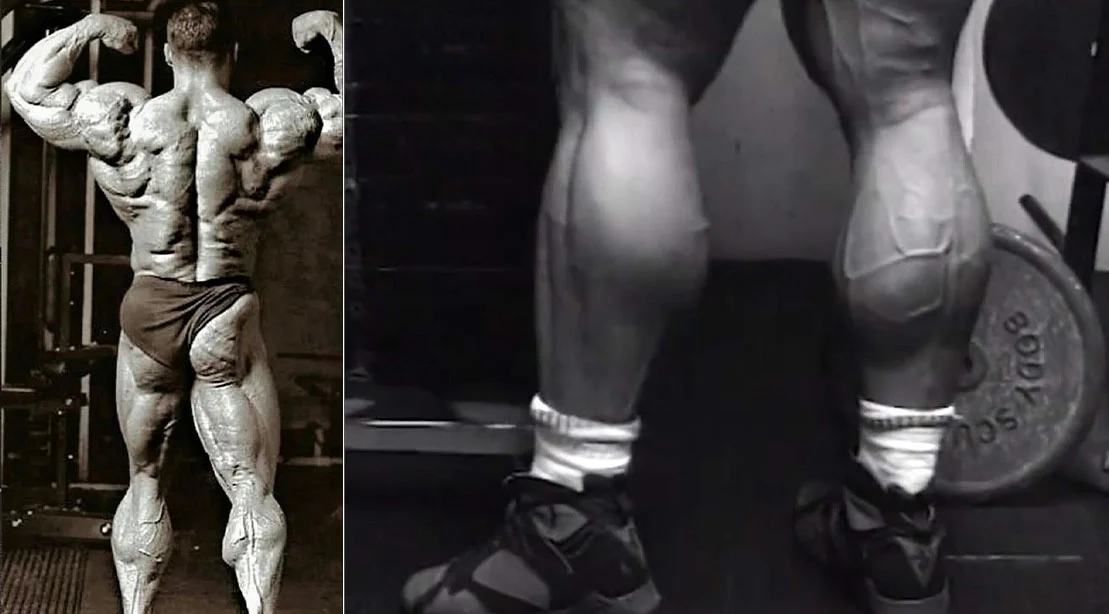
Dorian "The Shadow" Yates is a name etched into the annals of bodybuilding history, synonymous with the mass-monster era of the 1990s. As a six-time consecutive Mr. Olympia champion, Yates revolutionized the sport by introducing a level of density, conditioning, and sheer muscularity that had never been seen before. While his gargantuan chest, granite-like shoulders, and thick, sweeping back were the hallmarks of his physique, Yates was a master of the finer details. He understood that a championship-winning look was not merely about size—it was about complete, head-to-toe structural integrity.
For many aspiring bodybuilders, the lower legs represent the ultimate "stubborn" body part. Often dismissed as a product of genetic predisposition, the calves are frequently neglected in favor of more "glamorous" movements like the bench press or the barbell squat. However, Yates consistently demonstrated that with the correct mechanical application and an uncompromising intensity, the calves could be sculpted into the iconic diamond shape that defines a pro-level physique. Recently, the British legend took to social media to peel back the curtain on the exact methodology he used to build his own formidable lower legs, offering a masterclass in anatomical training.
The Foundation: Understanding the Calf Complex
To understand why Yates favored specific movements, one must first understand the anatomy of the lower leg. The calf complex is primarily composed of two distinct but synergistic muscles: the gastrocnemius and the soleus.
The gastrocnemius is the larger, more visible muscle belly that sits atop the lower leg, providing the distinct "diamond" shape when the leg is straightened. Because it crosses the knee joint, the gastrocnemius is most effectively targeted when the leg is fully extended, as seen in standing calf raises.
Deep beneath the gastrocnemius lies the soleus, a flat, broad muscle that contributes significantly to the overall thickness and width of the lower leg. Because the soleus does not cross the knee joint, it remains largely inactive when the knee is locked. However, when the knee is flexed—as it is during a seated calf raise—the gastrocnemius is placed at a mechanical disadvantage, forcing the soleus to take on the lion’s share of the workload. Yates’ genius lay in his ability to isolate these two muscles through specific postural adjustments, ensuring that no muscle fiber went un-stimulated.
Chronology of a Champion: The Evolution of Yates’ Training
Dorian Yates’ journey to the Olympia stage was characterized by a transition from traditional high-volume bodybuilding to his signature "Blood & Guts" High-Intensity Training (HIT) philosophy. Influenced by the teachings of Mike Mentzer, Yates moved away from the "more is better" mentality that dominated the gym culture of the 80s. Instead, he embraced a "less is more, but with absolute intensity" approach.
Throughout his professional career, Yates viewed calf training not as an afterthought to be tacked on at the end of a workout, but as a critical component of his leg day. By the time he was securing his second and third Sandow trophies, his calf routine had become a refined, two-movement protocol. He realized that the calves, being muscles utilized for daily locomotion, required extreme stimulus to force adaptation. His routine was built on a chronological progression: starting with the heavy, standing movements to tax the larger gastrocnemius, followed by the seated isolation work to fatigue the soleus.
The Standing Calf Raise: Building the Diamond
Yates famously championed the standing calf raise as the primary driver of calf development. In his recent disclosures, he emphasized that the key to success was not merely the weight on the machine, but the range of motion and the "squeeze."
"I stepped in and drove up, pretty much on my tip-toes with a huge squeeze and right the way down," Yates explained to his global audience. This emphasis on the "squeeze" is vital; it ensures that the fascia surrounding the muscle is stretched and contracted under load. For Yates, the standing calf raise was a test of willpower as much as physical strength. He was known to load the machine with upwards of 1,500 pounds, a staggering amount of weight that demanded perfect form to prevent injury and ensure the tension remained on the target muscle rather than the Achilles tendon or the joints.
The Mechanism of Failure
Yates’ philosophy on training to failure is legendary. He argued that most lifters quit when the pain begins, whereas the real growth occurs in the reps that follow. In his calf training, he advocated for a rep range of 8 to 12. If a lifter could perform more than 12 reps, the weight was too light; if they failed before 8, the weight was too heavy. Once he reached technical failure—the point where he could no longer complete a full rep with perfect form—he would often incorporate "partial reps" or "burnouts." By continuing to pulse the weight in the lower half of the movement, he ensured that every remaining ounce of energy was depleted from the muscle fibers.
The Seated Calf Raise: Targeting the Soleus
If the standing calf raise is the architect of the diamond shape, the seated calf raise is the sculptor of lower leg mass. Yates noted that the seated calf raise is essential because it removes the stabilizing muscles of the upper body and core from the equation, allowing for a pure, localized burn in the soleus.
"Since the knees are bent, it targets the soleus," Yates explained. By keeping the knees flexed, he effectively "bypassed" the gastrocnemius, forcing the soleus to contract independently. This distinction is what separates the average physique from a pro-level one. The soleus, when well-developed, pushes the gastrocnemius outward, creating a wider, thicker lower leg that looks impressive from both the front and the side.
Yates typically operated in the 220-pound range for seated movements, focusing on forced reps—a technique where a training partner assists just enough to allow the lifter to complete a few more reps beyond the point of failure. This method, combined with his strict focus on the mind-muscle connection, allowed him to achieve the vascularity and hardness that became his signature.
Supporting Data: Why "Neglect" is the Enemy
In the modern fitness landscape, many gym-goers cite "bad genetics" as the reason for small calves. While it is scientifically true that muscle insertion points—specifically the length of the Achilles tendon—are determined by genetics, it is a fallacy to suggest that growth is impossible.
Studies in exercise physiology support Yates’ approach. Research shows that the calf muscles respond best to high-tension loads and varied angles of knee flexion. The gastrocnemius is composed of a high percentage of Type II (fast-twitch) muscle fibers, meaning it thrives under heavy, explosive-style training. The soleus, by contrast, is more endurance-oriented (Type I fibers) but still requires high-intensity stimulation to grow significantly. By ignoring both, athletes leave massive potential for lower-body development on the table.
Official Responses and Industry Implications
The bodybuilding community has reacted with renewed vigor to Yates’ recent insights. Leading coaches and trainers have praised the "Shadow" for simplifying the science of calf training. In an era where complex "bio-hacking" and unnecessary equipment dominate social media, Yates’ return to the basics serves as a reminder that intensity is the ultimate variable.
The implications for the average gym-goer are clear:
- Intensity over Volume: Stop doing 50-rep sets of "bouncing" calf raises. Focus on heavy, controlled reps that reach true muscular failure.
- Postural Awareness: Ensure that the knee is fully extended for standing work and fully flexed for seated work to properly split the load between the gastrocnemius and the soleus.
- Full Range of Motion: As Yates noted, the stretch at the bottom of the movement is just as important as the contraction at the top. Dropping the heels as low as possible creates the necessary micro-trauma for growth.
Conclusion: The Shadow’s Legacy
Dorian Yates’ influence extends far beyond his six Olympia titles. He remains a pillar of wisdom in a sport that is often clouded by misinformation. By sharing his specific protocols for calf training, he has provided a roadmap for those willing to endure the discomfort required to build a world-class physique.
Calf training is rarely fun. It is a grueling, repetitive process that requires mental fortitude and a high pain threshold. However, as "The Shadow" aptly puts it: "Train your calves with real intention. Real focus, full range of motion, down to your heels and up on your toes!" For those who heed his advice, the result is not just larger calves, but the profound satisfaction that comes from mastering the smallest details of the human form. In the pursuit of greatness, no muscle is too small to ignore, and no detail is too fine to overlook.