








For centuries, the human olfactory system—the biological machinery that allows us to detect the scent of rain, the aroma of a morning coffee, or the acrid sting of a hazard—has been regarded as a biological enigma. While our eyes, ears, and skin operate through clearly mapped sensory pathways, smell has remained, in the words of neuroscientists, "the mysterious sense."
A groundbreaking study published April 28 in the journal Cell has finally pulled back the curtain on this biological mystery. By utilizing cutting-edge genetic sequencing and spatial mapping, researchers at Harvard Medical School have constructed the first detailed, high-resolution map of smell receptors within the nose. This discovery challenges decades of scientific assumptions and provides a foundational blueprint that could eventually lead to revolutionary treatments for the millions suffering from olfactory loss.
The Mystery of the Missing Map
The sense of smell is far more than a mere luxury; it is a critical sentinel for safety, a vital component of flavor, and a powerful trigger for the brain’s emotional and mnemonic centers. Despite its profound influence on daily life, the "how" of olfaction has long eluded researchers.
"Olfaction is super-mysterious," says Sandeep (Robert) Datta, a professor of neurobiology at the Blavatnik Institute at Harvard Medical School and the study’s senior author. "Compared with vision, hearing, and touch, the basic biology of smell has remained less understood."
To understand why this has been so difficult, one must consider the sheer scale of the challenge. While human color vision relies on just three types of receptors, the olfactory system is a sprawling, complex network. Mice—the standard model for this research—possess approximately 20 million olfactory neurons, each expressing one of over a thousand distinct receptor types. Each receptor is calibrated to detect specific odor molecules, creating a computational complexity that has stymied researchers for decades.
A Historical Context: From Randomness to Order
The scientific quest to map the nose began in earnest in 1991, when researchers first identified the molecular nature of smell receptors. Throughout the 1990s and early 2000s, the prevailing wisdom suggested that these receptors were distributed in a broad, somewhat random, or vaguely zoned fashion across the nasal cavity. Because scientists lacked the tools to see the precise placement of millions of individual neurons, the olfactory system was categorized as "disorganized" compared to the highly structured wiring of the visual cortex.
For years, this assumption hindered progress. "Olfaction has been the one exception," Datta notes. "It’s the sense that has been missing a map for the longest time."
The turning point came with the advent of "spatial transcriptomics"—a revolutionary method that allows scientists to simultaneously identify the genetic signature of a single cell and pinpoint its exact physical location within a tissue. By combining this with massive single-cell sequencing, the Harvard team was finally equipped to tackle the complexity that had defeated previous generations of researchers.
Decoding the Data: 5.5 Million Neurons and a Hidden Pattern
To achieve a resolution never before seen in sensory biology, Datta and his colleagues analyzed roughly 5.5 million neurons across more than 300 mice. This data set is, by many accounts, the most extensively sequenced neural tissue in scientific history.
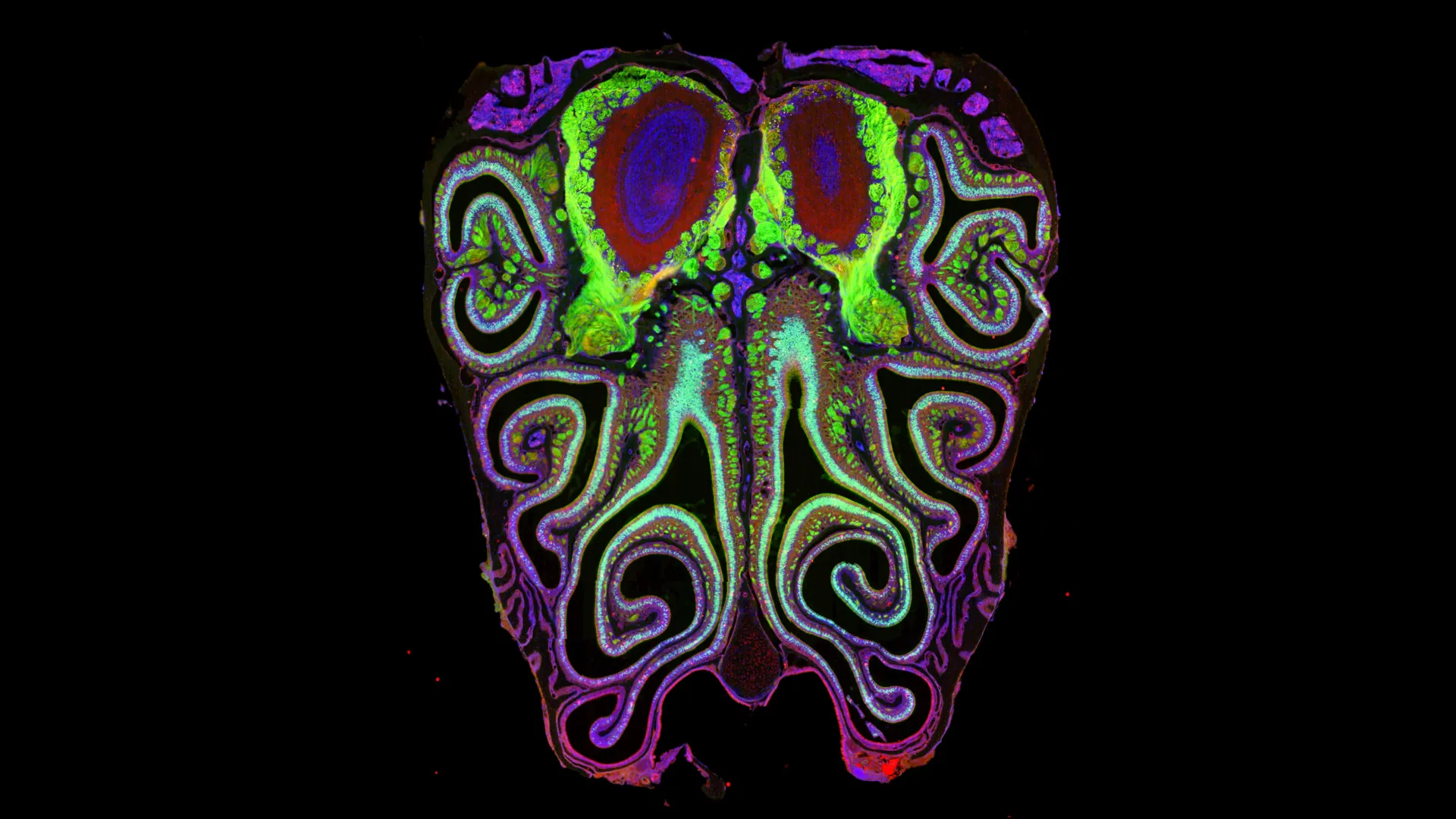
The findings were transformative. Instead of a disorganized, chaotic distribution of receptors, the researchers discovered a highly disciplined structure. The neurons carrying specific smell receptors are grouped into horizontal bands, or "stripes," that run elegantly from the top of the nose to the bottom.
"Our results bring order to a system that was previously thought to lack order, which changes conceptually how we think this works," says Datta.
Further analysis revealed that these stripes are not merely a feature of the nasal cavity; they align with corresponding maps within the olfactory bulb of the brain. This suggests that the "scent map" in the nose is a deliberate, pre-programmed architecture that dictates how sensory information is relayed and interpreted by the brain’s neural circuits.
The Developmental Blueprint: The Role of Retinoic Acid
A key question remained: How does the body build such a precise, consistent map? The researchers investigated the developmental biology of these neurons and identified a surprising architect: retinoic acid.
Retinoic acid is a molecule known for regulating gene activity during embryonic development. The study found that a gradient of retinoic acid within the nose acts as a spatial guide, signaling to each neuron exactly which receptor it should activate based on its position in the nasal lining.
To test this hypothesis, the team manipulated the levels of retinoic acid in experimental models. The results were striking: the entire map of receptors shifted upward or downward in response to the altered chemical gradient. This confirmed that the "stripes" of smell are not random occurrences but are the result of a precise, chemically guided developmental program.
The study’s findings were bolstered by a simultaneous paper published in the same issue of Cell by the lab of Catherine Dulac, the Xander University Professor in the Department of Molecular and Cellular Biology at Harvard, which reported consistent and complementary results.
Implications for Human Health and Beyond
While the study was conducted in mice, the implications for human health are profound. The loss of smell—often exacerbated by aging, viral infections like COVID-19, or neurodegenerative conditions—remains a significant medical challenge with few effective clinical interventions.
"We cannot fix smell without understanding how it works on a basic level," Datta emphasizes.
By defining the map, researchers have finally established a target for regenerative medicine. If the olfactory system is organized by a specific, mappable, and chemically guided architecture, scientists may one day be able to utilize this map to guide stem cell therapies. The goal is to replace damaged neurons and ensure they wire themselves correctly into the existing olfactory circuitry.
Furthermore, the discovery of this "map" could provide a roadmap for future brain-computer interfaces. If we understand how the nose sends signals to the brain, we could potentially bypass damaged nasal tissue and stimulate the olfactory bulb directly, or encourage the brain to reorganize and recover lost function.
"Smell has a really profound and pervasive effect on human health," Datta notes. "Restoring it is not just for pleasure and safety but also for psychological well-being. Without understanding this map, we’re doomed to fail in developing new treatments."
Looking Toward the Future
The Harvard team is already looking toward the next phase of the research. They are currently investigating why the receptor stripes appear in their specific order and, perhaps most importantly, determining whether this same organizational logic holds true for the human olfactory system.
As the scientific community digests these findings, the sense of smell is being moved from the periphery of sensory research to the center. The "missing map" has been found, and with it, a clearer path toward understanding how we perceive the world around us.
Acknowledgments and Funding
The study, titled "The Olfactory Receptor Map," involved a large team of contributors, including David Brann, Tatsuya Tsukahara, Cyrus Tau, Dennis Kalloor, Rylin Lubash, Lakshanyaa Kannan, Nell Klimpert, Mihaly Kollo, Martin Escamilla-Del-Arenal, Bogdan Bintu, Andreas Schaefer, Alexander Fleischmann, and Thomas Bozza.
Funding for this monumental project was provided by the National Institutes of Health (grants R01DC021669, R01DC021422, R01DC021965, and F31DC019017), the Yang Tan Collective at Harvard, and a National Science Foundation Graduate Research Fellowship. These investments in basic science have yielded a discovery that fundamentally alters our understanding of one of the most vital human senses.