







NEW YORK — Newly uncovered documentation has cast a significant shadow over the credibility of U.S. Health Secretary Robert F. Kennedy Jr., revealing a stark contradiction between his sworn testimony to Congress and his private correspondence regarding a 2019 mission to Samoa.
During his high-stakes confirmation process last year, Kennedy repeatedly assured skeptical lawmakers that his visit to the Pacific island nation—which occurred just months before a catastrophic measles outbreak—was purely administrative and "had nothing to do with vaccines." However, a letter obtained by The Associated Press and The Guardian reveals that Kennedy, then a leading figure in the anti-vaccine movement, had explicitly requested to study Samoa’s MMR (measles, mumps, and rubella) vaccine program in the wake of the deaths of two local children.
The revelation has ignited a firestorm of scrutiny, raising urgent questions about the transparency of the current administration and whether the Senate was misled during the confirmation of a cabinet official overseeing the nation’s public health apparatus.
A Pattern of Contradiction
Throughout his confirmation hearings, Kennedy faced intense questioning from senators concerned about his long history of anti-vaccine rhetoric. With his appointment hanging in the balance, he sought to reassure the Health, Education, Labor and Pensions Committee that he intended to work within the bounds of established medical science.
When pressed specifically on his 2019 trip to Samoa by Senator Ron Wyden (D-Ore.), Kennedy was unequivocal: "I went there, nothing to do with vaccines. I went there to introduce a medical informatics system that would digitalize records in Samoa and make health delivery much more efficient."
The following day, under further pressure from Senator Edward Markey (D-Mass.), Kennedy doubled down, stating, "My purpose in going down there had nothing to do with vaccines."
The newly surfaced letter, dated January 20, 2019, paints a drastically different picture. Writing on the letterhead of Children’s Health Defense (CHD)—the anti-vaccine nonprofit he chaired at the time—Kennedy wrote to the Samoan Prime Minister proposing that his team conduct a "detailed health informatics assessment" specifically to investigate the deaths of two children who had received the MMR vaccine. In that single missive, Kennedy used the words "vaccine" or "vaccination" eight times, focusing his pitch entirely on the potential for manufacturing issues within the vaccine supply chain.
Chronology of a Controversial Mission
The origins of the visit trace back to July 2018, when two infants in Samoa died after receiving an improperly prepared MMR vaccine. The incident was quickly linked to human error by local nurses, who were later convicted of manslaughter.
- July 2018: Two children die following the administration of a contaminated vaccine; the Samoan government halts the vaccination program.
- January 2019: Kennedy sends a formal letter to the Samoan Prime Minister, proposing an investigation into the MMR program, citing concerns over "manufacturing issues."
- February 2019: The Prime Minister responds, welcoming the "independent health assessment" of the nation’s MMR vaccines.
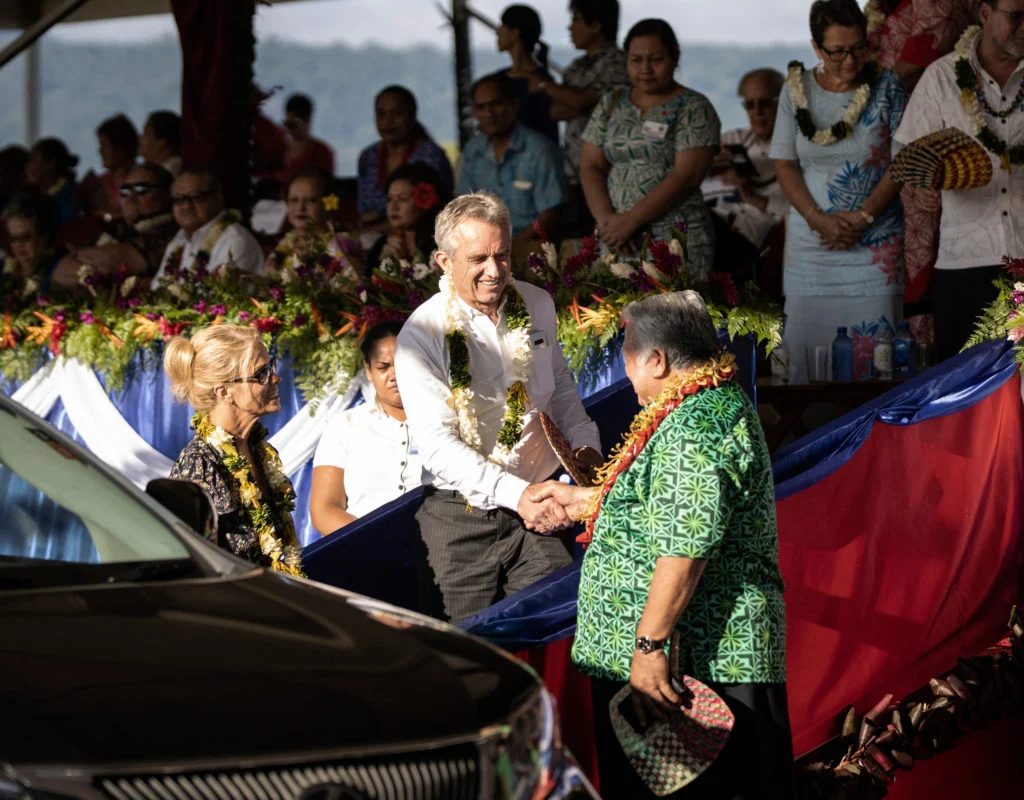
- May-June 2019: Kennedy, accompanied by his wife, actor Cheryl Hines, and colleagues from CHD, visits Samoa. By this time, the government had already resumed vaccination efforts, but the local public health infrastructure remained fragile.
- Late 2019: A devastating measles outbreak sweeps the island, claiming the lives of 83 people, the vast majority of whom were children under the age of five.
Critics, including international public health officials, have long argued that Kennedy’s visit and his subsequent engagement with local anti-vaccine activists served to provide intellectual cover for those opposing immunization. While vaccination rates were already low due to the government’s pause, public health experts contend that the presence of a high-profile American activist emboldened skepticism, ultimately hampering the reach of the catch-up vaccination campaign that followed.
Supporting Data: The Disconnect
The disparity between Kennedy’s public defense and his private intentions is quantified by the language in his own documents. In his January 2019 letter, Kennedy argued that it was "difficult and time-consuming" in most parts of the world to investigate "adverse health events associated with vaccines." He proposed that his team’s informatics assessment would bridge the gap between "diagnoses and specific vaccination events."
This language directly contradicts his later claims to the Senate that the trip was purely about modernizing health records. Public health records and internal communications from the U.S. State Department and UNICEF, also obtained via Freedom of Information requests, confirm that government officials on the ground were acutely aware that the focus of Kennedy’s visit was the vaccine program.
Furthermore, the impact of his visit was compounded by the timing. When Kennedy arrived in May 2019, the Samoan Ministry of Health had already publicly concluded that the earlier deaths were a result of a tragic, isolated incident of medical malpractice, not a systemic failure of the vaccine itself. Despite this, the correspondence shows Kennedy maintained a laser-focus on the vaccines.
Official Responses and Defenses
The Department of Health and Human Services (HHS) has taken a combative stance in response to the reports. In a written statement, the department dismissed the claims that Kennedy lied, labeling them "not only false but outright defamatory."
"The Samoa visit was unrelated to vaccines," an HHS spokesperson maintained, doubling down on the narrative Kennedy presented to the Senate.
When pressed on the fact that the letter exists in Kennedy’s own handwriting, the department declined to make the Secretary available for an interview. The White House has similarly remained silent, offering no comment on whether the President retains confidence in the Secretary given the documented evidence of his conflicting statements.
Legal experts note that while Kennedy was not under oath during his confirmation hearing, the act of knowingly providing false material testimony to Congress is a federal crime under 18 U.S.C. § 1001. However, such statutes are rarely enforced in political contexts, especially when the executive branch remains in lockstep with the official in question.
Political Implications and the Future
The fallout from this disclosure has created a complex political landscape. Senator Bill Cassidy (R-La.), who provided the deciding vote for Kennedy’s confirmation, has previously expressed his frustration with the Secretary. Cassidy, a physician by trade, had secured specific pledges from Kennedy to maintain the independence of federal vaccine advisory committees.
After Kennedy ousted all 17 members of the federal advisory committee shortly after taking office, Cassidy publicly stated that his trust had been "violated." The surfacing of the Samoa letters provides a new layer of ammunition for lawmakers who feel they were misled from the start.
"If the Secretary is willing to obfuscate about his past activities on such a sensitive global health issue, it raises fundamental questions about his stewardship of the Department," said one staffer on the Senate Health Committee, speaking on condition of anonymity.
While some legal scholars suggest these documents could serve as grounds for formal congressional oversight hearings or even an impeachment inquiry, the current political reality suggests such measures are unlikely. The Republican-led Congress, which remains largely aligned with the administration’s broader agenda, has shown little appetite for investigating the Secretary’s past.
Nevertheless, the incident serves as a significant case study in the intersection of international public health, political confirmation, and the power of the written record. For health advocates and critics alike, the Samoa letters represent more than just a past trip; they stand as a permanent marker of the gap between the rhetoric of a cabinet official and the documented reality of his career.
As the debate continues, the focus will likely shift toward whether these documents will impact future policy decisions or if they will be relegated to the growing list of historical points of contention surrounding the current administration’s health leadership.