



By: [Your Name/Editorial Team]
Featuring insights from: Robbie Majzner, MD, CRI Lloyd J. Old STAR
Over the past several decades, the landscape of pediatric oncology has shifted from a realm of near-certain mortality to one of remarkable survival. Thanks to advancements in chemotherapy, radiation, and surgical intervention, the majority of children diagnosed with cancer today will survive their disease. However, beneath these encouraging statistics lies a more complex reality: some childhood cancers remain stubbornly resistant to conventional therapies, and the "cure" often comes at the cost of life-long health complications caused by the intensity of the treatment itself.
As we observe Childhood Cancer Awareness Month, the medical community is forced to confront a critical realization: we can no longer rely on a "trickle-down" approach, where treatments developed for adult malignancies are simply scaled down for younger patients. Childhood cancers are not merely smaller versions of adult cancers; they are biologically distinct, driven by different mechanisms, and require a fundamentally unique approach to treatment.
Leading this charge is Dr. Robbie Majzner, a pediatric oncologist and physician-scientist supported by the Cancer Research Institute (CRI) through the Lloyd J. Old STAR program. His work is at the forefront of a paradigm shift in how we treat the most challenging pediatric cases.
The Biological Disconnect: Why Pediatric Cancer is Unique
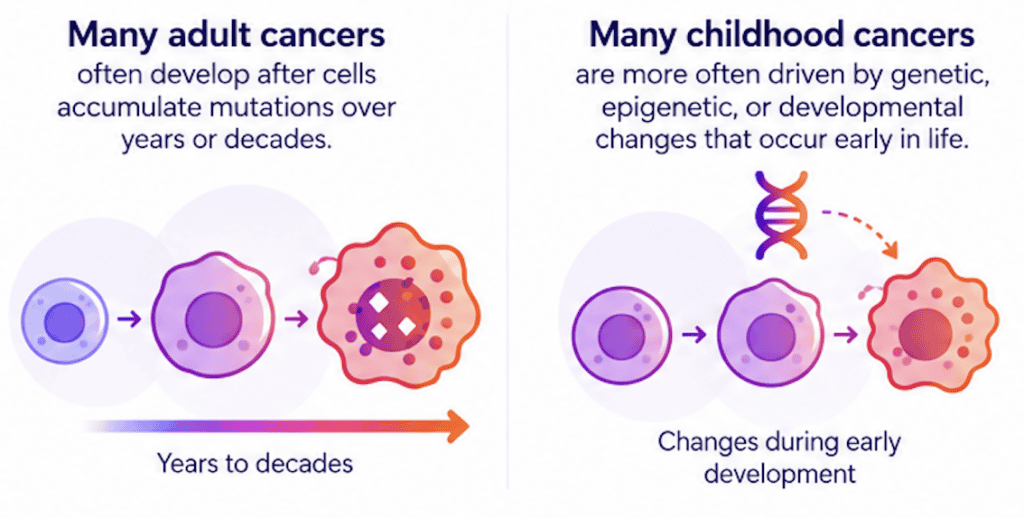
To understand why traditional adult cancer therapies often fall short in pediatrics, one must first understand the fundamental biology of these diseases. Adult cancers are frequently the result of cumulative environmental exposure—decades of accumulated genetic mutations in mature cells.
In contrast, childhood cancers are often, as Dr. Majzner describes them, "a product of aberrant development." These cancers arise during the rapid growth and development of a child’s body, often driven by genetic or epigenetic "glitches" that occur as cells navigate their normal developmental pathways. Because these tumors are born from different biological processes, they often lack the high mutational burden found in many adult cancers.
The "Brake" Problem
In adult oncology, immune checkpoint inhibitors have revolutionized treatment by removing the "brakes" that keep the immune system from attacking tumors. These therapies function by unleashing existing T cells that have already identified the cancer. However, because many pediatric cancers have relatively few mutations, they are often "invisible" to the immune system. If the T cells haven’t identified the tumor as a threat, simply releasing the brakes provides no benefit. This is the core reason why pediatric oncology requires a bespoke, rather than a hand-me-down, strategy.
A Chronology of Progress: From Lab to Bedside
The evolution of pediatric immunotherapy has been a painstaking process of discovery, moving from fundamental biological research to the clinical successes we see today.
- The Early Foundation (Late 20th Century): Scientists began to map the distinct genetic signatures of childhood leukemias and sarcomas, separating them from adult counterparts.
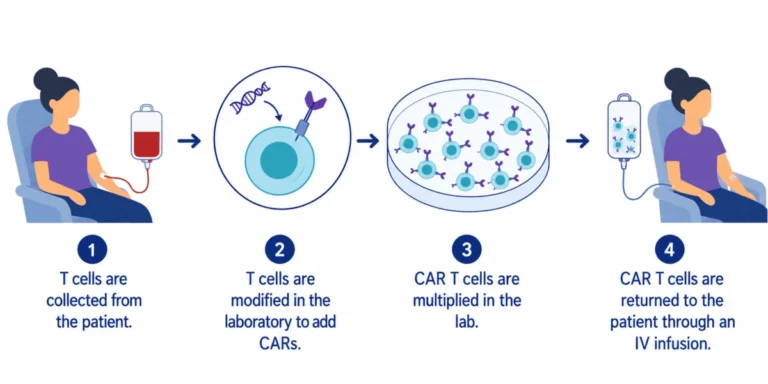
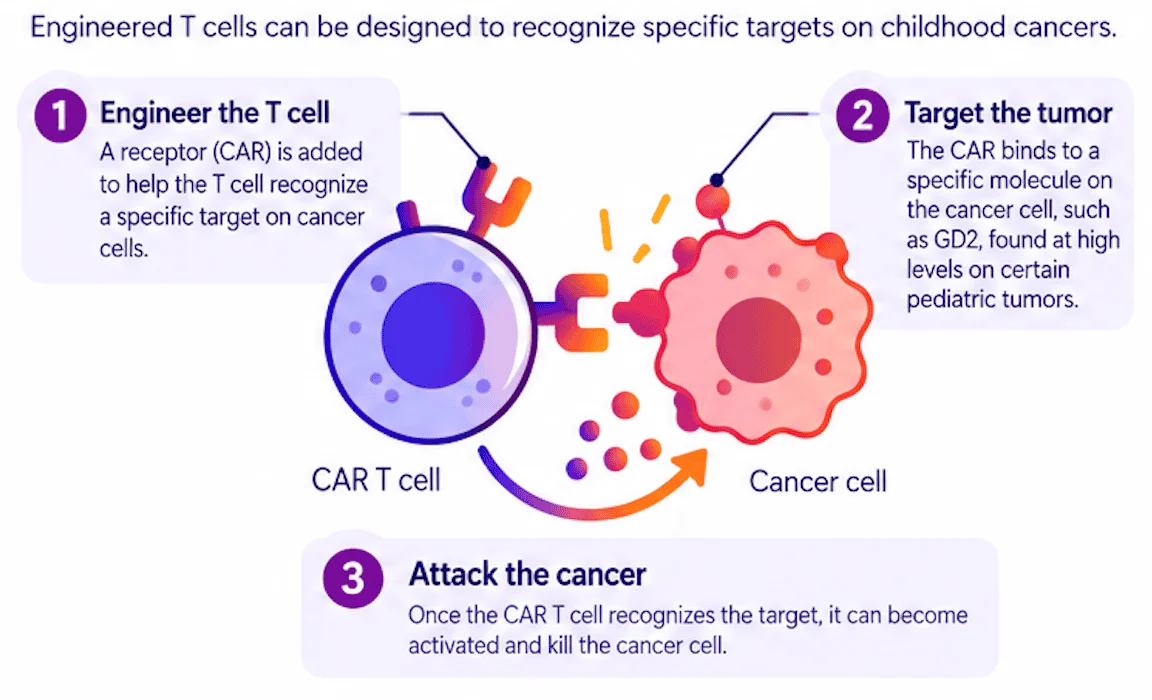
- The Rise of Adoptive Cell Therapy (2010s): The emergence of CAR T-cell therapy marked a watershed moment. By engineering a patient’s own T cells to recognize specific tumor antigens, researchers could bypass the need for a pre-existing immune response.
- The Breakthrough in Leukemia: CAR T-cell therapy proved remarkably effective in certain pediatric B-cell leukemias, offering hope where traditional chemotherapy had failed.
- The Current Era (2020–Present): The focus has expanded to the "Holy Grail" of pediatric oncology: solid tumors. Researchers like Dr. Majzner are now applying the lessons learned from leukemia to aggressive brain tumors, such as diffuse midline glioma (DMG).
Supporting Data: The Case for Targeted Engineering
The efficacy of modern immunotherapy hinges on precision. Dr. Majzner’s laboratory is currently tackling two sides of the therapeutic coin: the engineering of the T cell and the identification of the target on the tumor.
One of the most promising areas of study involves the molecule GD2. Research conducted at Stanford University—led by Dr. Majzner and his colleagues—revealed that the biology of aggressive pediatric brain tumors, such as DMG, actively drives the expression of GD2. This discovery was not just a scientific curiosity; it provided the essential "target" for CAR T-cell design.
Clinical Observations:
- Targeting Efficiency: By engineering CAR T cells to lock onto GD2, researchers have observed a "synthetic immune response," where the T cells are redirected to recognize and destroy tumors that were previously invisible to the patient’s immune system.
- Patient Outcomes: Early-phase clinical trials have yielded encouraging results, including long-term remissions in some of the most aggressive cases and measurable improvements in neurological symptoms.
- The "Off-Target" Challenge: A significant part of current research focuses on "tuning" these receptors to ensure they can distinguish between cancerous cells and healthy tissue, a vital step in minimizing side effects for growing children.
The Role of High-Risk, High-Reward Funding
The advancement of these technologies is often hindered by the "valley of death"—the period between a basic discovery and a proven clinical product where funding is notoriously difficult to secure. Because childhood cancer populations are smaller than adult populations, traditional market incentives are often absent.
Dr. Majzner emphasizes that without programs like the CRI Lloyd J. Old STAR grant, the field would stagnate. "If you just shut down all high-risk ideas, we will never get new technologies," he explains. This funding allows his team to explore fundamental T-cell signaling—the "how" of cellular communication—without the immediate pressure to produce a blockbuster drug. It is a testament to the scientific method that the very receptors his lab engineers today rely on basic, decades-old research into T-cell signaling that was conducted long before CAR T-cell therapy was even a theoretical possibility.
Implications: The Future of Pediatric Oncology
The goal of the next generation of cancer research is twofold: to increase survival rates and to improve the quality of life for survivors. The current intensity of chemotherapy often leaves children with permanent, life-altering health issues, including heart problems, infertility, and cognitive impairment.
Emerging Technologies on the Horizon
- In Vivo CAR T-Cell Therapy: A game-changing approach that aims to engineer the T cells directly inside the patient’s body, potentially eliminating the need for complex and time-consuming laboratory cultivation.
- Antibody-Drug Conjugates: The use of targeted antibodies to deliver chemotherapy directly to the tumor, sparing the rest of the child’s developing body from systemic toxicity.
- Tailored Biology: The shift from "one-size-fits-all" to "biologically-driven" medicine. As we better understand the specific developmental pathways of individual pediatric tumors, we can design therapies that act as a scalpel rather than a sledgehammer.
Conclusion: A New Chapter
The story of childhood cancer research is being rewritten. While the progress made in the 20th century provided the baseline for survival, the 21st century is providing the tools for a cure that respects the unique physiology of a child.
As Dr. Majzner and his colleagues continue to push the boundaries of immunotherapy, the focus remains clear: the objective is not simply to help children survive their cancer, but to ensure they have the health and vitality to thrive long after the treatment is complete. By moving away from the "trickle-down" model and embracing the unique, albeit complex, biology of pediatric tumors, the medical community is moving closer to a future where childhood cancer is not a life-defining event, but a treatable, and ultimately beatable, hurdle.
The work ahead is significant, but the foundation laid by researchers and supported by organizations like the Cancer Research Institute is stronger than ever. For the families currently navigating the daunting journey of a childhood cancer diagnosis, this research is more than just data—it is the promise of a brighter, healthier tomorrow.