











Published May 13, 2026 | From the Yoga Journal Archives (Originally published May-June 1981)
In the vast landscape of yoga equipment—from foam blocks and heavy bolsters to intricate inversion swings—the most sophisticated tool available to the practitioner is likely already in their home. It is immovable, ubiquitous, and entirely free: the humble wall.
As part of Yoga Journal’s ongoing archival series, which resurfaces foundational wisdom from our 1975 inception to the present, we revisit a classic 1981 exploration of wall-supported practice. While the aesthetic of yoga has shifted over the last four decades, the mechanical and philosophical benefits of using the wall as a "yoga partner" remain as vital today as they were when this piece was first penned.
The Evolution of the Wall: From Architecture to Asana
For the modern student, the wall is often dismissed as a mere boundary. However, in the context of the Iyengar-influenced traditions that shaped the 1980s yoga boom, the wall was repositioned as a precision instrument.
The primary challenge for the wall-practitioner is, unsurprisingly, aesthetic. As noted in our 1981 records: "Footprints will eventually appear on your walls five feet above the floor. These may be difficult to explain to guests or the landlord." While this remains a universal truth, the seasoned yogi eventually learns to prioritize alignment over interior design. Whether it is washing one’s feet before practice or simply accepting the "signs of dedication" left behind, the wall acts as a silent witness to the practitioner’s progress.
Supporting the Inversions: Headstand and Shoulderstand
The wall serves a dual purpose in inversions: it is a safety net for the fearful and a refined feedback mechanism for the advanced.
The Psychology of Headstand
For beginners, the fear of falling during Sirsasana (Headstand) is the greatest obstacle to proper form. When the wall is used to prevent "tumbling backward," it allows the student to focus on the essential task: finding verticality.
However, the wall should never become a permanent crutch. The ultimate goal remains mastering the pose in the center of the room. Yet, even the master can find utility in the wall. By walking the heels a few inches up the wall after entering the pose, the practitioner can achieve an extraordinary extension of the spine. This corrects the common misconception that Headstand is about "crushing" weight into the skull. Instead, it becomes an upward reach—shoulders lifting away from the ears, pelvis lengthening away from the ribs—transforming the pose from a gravity-bound struggle into an act of ascension.
Leveraging Stability in Shoulderstand
In Sarvangasana (Shoulderstand), the wall provides the leverage necessary to achieve true alignment. By lying on the floor and pivoting the legs up the wall, the student can focus on the delicate mechanics of the back. Pressing the soles of the feet into the wall allows the practitioner to walk the hands higher up the back, bringing the chest toward the chin and straightening the spine. This creates the stability required to bring the elbows closer together, a refinement that is often impossible to maintain without the external resistance provided by the wall.
The Geometry of the Twist
Twists are among the most complex movements in the yogic repertoire. They require a synchronization of balance, rotation, and breath that often leads to "spinal confusion"—where the mind directs a movement the body is not yet prepared to execute.
Improving Alignment in Standing and Seated Twists
In Parivrtta Trikonasana (Revolved Triangle), the wall acts as a navigational guide. By placing the chest or the back against the wall, the student gains an immediate sense of their own spatial orientation.
- The Chest-to-Wall approach: Encourages the rotation of the underside of the torso.
- The Shoulder-to-Wall approach: Provides a fixed point for the upper shoulder, deepening the rotational integrity of the upper back.
For seated twists, such as Marichyasana I, the wall serves as a point of resistance. By pressing the hands into the wall, the student gains the leverage needed to "spiral" the torso. This technique is particularly restorative for those recovering from physical trauma or childbirth, as it allows for a controlled, supported return to spinal mobility.
Seated Poses and the Laboratory of the Body
The wall’s utility extends into the foundational seated postures that form the bedrock of a daily practice.
Correcting the Foundation
In poses like Dandasana (Staff Pose) or Baddha Konasana (Bound Angle Pose), keeping the spine perpendicular to the floor is a constant battle against gravity. Sitting against the wall provides a tactile prompt for the spine to remain upright.
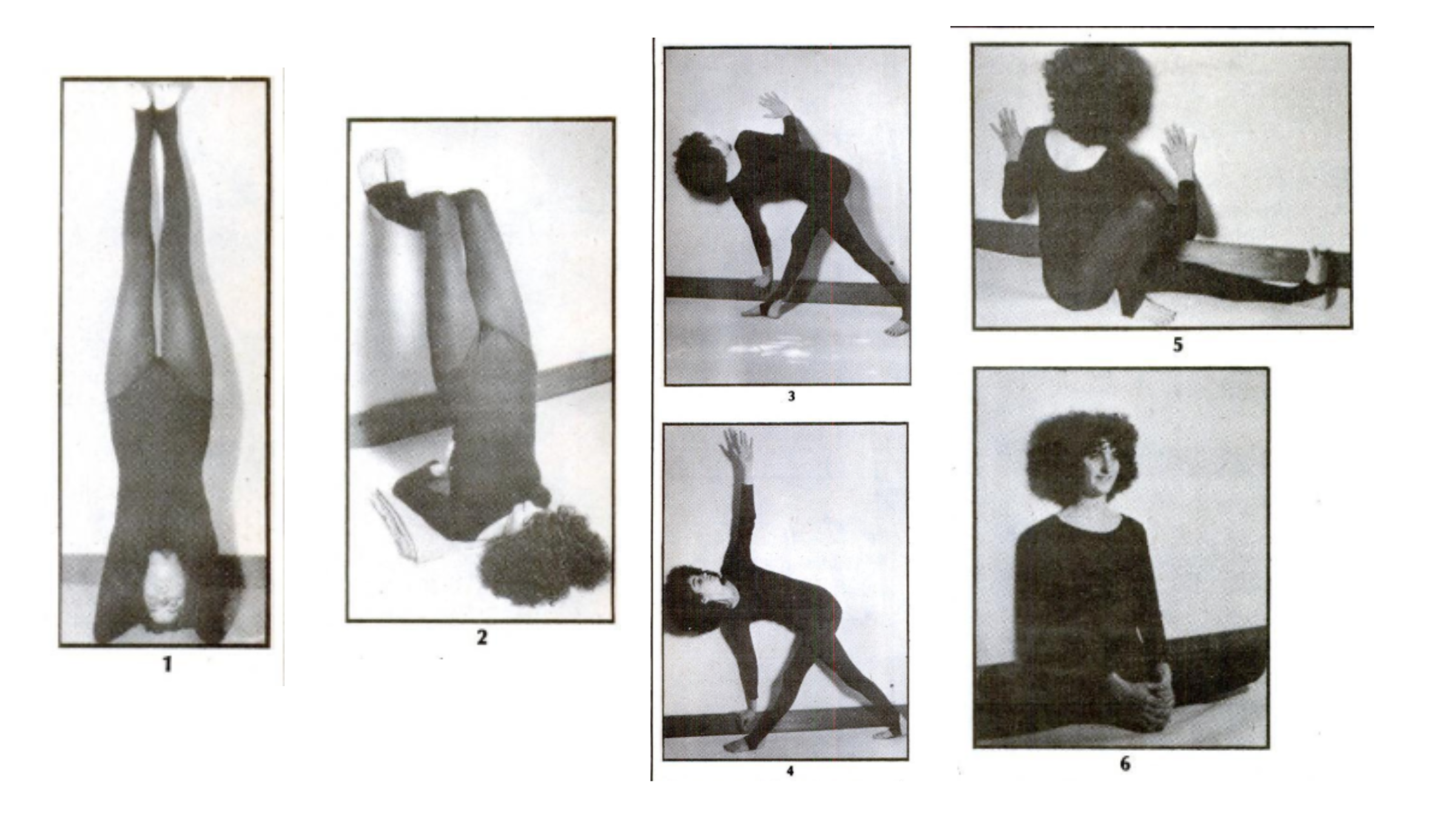
Furthermore, the wall is a diagnostic tool for the feet. Many students allow their feet to roll inward or outward during forward bends, a seemingly minor detail that cascades into imbalances up the leg and into the hip joint. By pressing the soles of the feet firmly against the wall, the student forces the legs into proper alignment.
The Body as a Field of Experimentation
As B.K.S. Iyengar famously posited, "To a yogi, the body is a laboratory, a field of experiments and perpetual researches." When a student transitions from practicing without the wall to practicing with it, they move from guessing about their anatomy to feeling it.
The wall provides "data" to the practitioner. When you press your feet into the wall during a forward bend, you can feel the engagement of the adductors and the release of the hamstrings. You are not just doing a pose; you are conducting research on your own physical architecture.
Implications for Modern Practice
The enduring lesson of the 1981 archive is that yoga does not require a studio, a mat, or specialized props to be effective. It requires attention. The wall is merely a tool to focus that attention.
In our contemporary era, where "yoga" is often commodified through high-end studios and digital aesthetics, the return to the wall is a return to the basics of physical intelligence. It is a reminder that the most profound yoga is that which is done with intention, consistency, and a willingness to see the body as a site of discovery.
Whether you are a beginner struggling to balance in an inversion or an advanced practitioner looking to refine the nuances of a twist, the wall remains the ultimate mentor. It does not judge, it does not fatigue, and it is always ready to hold the weight of your practice. As you incorporate these techniques, remember the advice from our 1981 archives: observe the feedback your body provides. Let the wall be your guide, let the floor be your foundation, and let your practice be your own personal laboratory of research.
Acknowledgments: This article is indebted to the pioneering work of B.K.S. Iyengar, whose structural approach to yoga continues to define the practice for millions. Special thanks to our 1981 model, Pamela Wayne, for her demonstration of these fundamental techniques.